
Canada supports women in Bolivia : driving tropical Andes conservation
© Consejo Regional T’simane Mosetenes Pilón Lajas (CRTM)
Canada recognizes that protecting biodiversity abroad and at home helps build strong, sustainable economies and creates healthier and more resilient societies. Canada’s 2023 to 2026 International Biodiversity Program helps developing countries to fulfill their commitments. The Kunming-Montreal Global Biodiversity Framework helps to restore, conserve and sustainably use biodiversity.
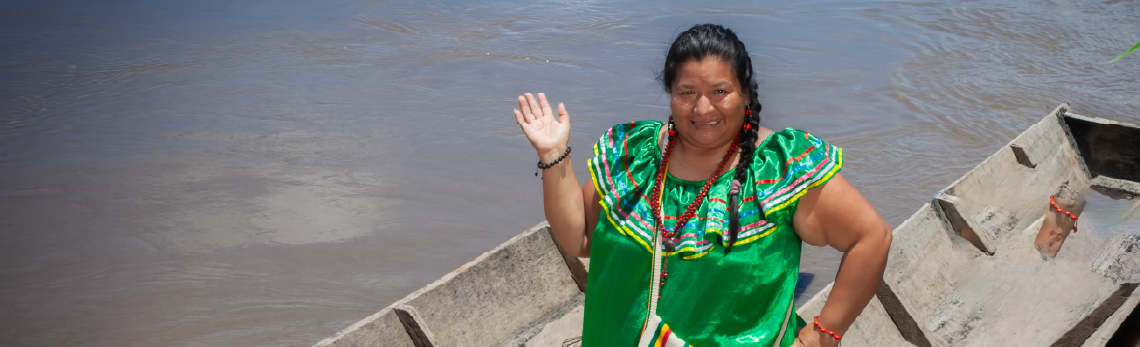
“We women fight for the conservation, protection and care of our territories,” said Magali Tipuni, an Indigenous Tacana woman who is the President of the Consejo Regional T’simane Mosetenes Pilón Lajas (the Council). Magali has become one of the most recognized voices in the region as a defender of the territory and the conservation of the Pilón Lajas Biosphere Reserve in Bolivia. Indigenous communities hold the title to this area and govern it. The area is known for its diverse ecosystems and is an important part of the Madidi–Pilón Lajas–Cotapata Conservation Corridor.
Because of Magali’s leadership, her community has become an example of the transformation and expansion of women’s participation in decision making. The council is composed of 23 Tacana, T’same, Mosetén and Chipaya communities. Traditionally, only men held positions of authority, but this changed in 2021 when Magali was elected the Vice President. Then, in 2024, she became the President.
“Being a leader and wanting to support communities is very complicated, but my husband and children support me,” she said.
Her election marked a milestone for the organization. It also paved the way for other women in the region to train and take on leadership roles.
Magali’s mother used to be a midwife and a community president. When Magali was growing up, her mother would tell her, “You are strong, you must take care of your brothers and sisters and the people in your community.” Magali had limited resources, so she worked during the day and studied at night until she finished high school. She is the only woman in her family to do so.
Her desire to learn motivated her to participate in the Leadership in Conservation training program. She joined 44 other women from Colombia, Ecuador, Peru and Bolivia who are involved in conservation.
“I have learned a lot. Now I am more confident. The tools I received allow me to support other women to also take on leadership roles,” said Magali.
The Leadership in Conservation training program was implemented by the BYOS Soluciones Ambientales, supported by the Critical Ecosystem Partnership Fund, and funded by Canada’s International Biodiversity Program.
Part of a regional movement
Magali holds the 2 highest positions on the Council, which serves 23 communities. The network of women leaders that was created during the training program is an important source of support for her.
The Council created its own Critical Ecosystems Partnership Fund project in Bolivia, which was also funded by Canada’s International Biodiversity Program.
This project:
- provided women with gender equality training
- conducted a gender assessment in their communities
- wrote their first gender and inclusion policy
This allowed the Council to join the 42 Critical Ecosystem Partnership Fund grantee organizations in the Tropical Andes hotspot. As of October 2025, it had an active gender action plan, and its 25 grantee organizations have designed their first gender policy.
“The gender policy has allowed us to encourage women to get training, to speak up and to assert their opinions,” explained Magali.
Magali’s next step is to integrate men into this process. “It is not about excluding them, but about making them understand that women and men complement each other in continuing to care for our territory,” says Magali.
The Council is working to put a management plan and a life plan for the Pilón Lajas Reserve in place. These gender equality activities go hand in hand with their efforts.
The Council is taking action to:
- prevent wildfires
- support sustainable economic development (particularly with women in mind)
- raise awareness about the value of Pilón Lajas’ biodiversity
Magali’s story shows that women’s participation strengthens territorial management. It also transforms lives and community structures and opens real paths to equity and conservation. These women have helped improve the management of 405,347 hectares of the Yungas Inferiores de Pilón Lajas. This key biodiversity area includes the Pilón Lajas Reserve.
Through the Council’s project, 200 women and 30 men from the territory have participated in gender equity training.
Livelihood training has helped 70 women from the Council’s communities to earn income from activities such as:
- essential oil production
- tourism
- wool crafts
- seed crafts
In addition, 2,733 Indigenous individuals in Pilón Lajas (1,315 women and 1,418 men) have benefited non-monetarily through:
- improved territorial control as a result of joint patrols by park rangers and community members
- better local firefighting capacity because of new equipment
- revitalized traditional knowledge, especially through culture-based crafts
- stronger governance of their territory
“Magali is a role model who gives other women in the region the confidence to know that they, too, can become leaders. And they are becoming leaders,” said Michele Zador, Critical Ecosystem Partnership Fund grant director for the Tropical Andes biodiversity hotspot.
- Date modified:
