
Canada helps Cambodian women create an opportunity out of mangrove conservation

Canada recognizes that protecting biodiversity abroad and at home helps build strong, sustainable economies and creates healthier and more resilient societies. Canada’s 2023 to 2026 International Biodiversity Program helps developing countries to fulfill their commitments. The Kunming-Montreal Global Biodiversity Framework helps to restore, conserve and sustainably use biodiversity.
Mangroves help reduce property damage by more than CA$89 billion and protect more than 15 million people around the world.
When storms roll in from the Gulf of Thailand, the Koh Kapik mangroves are the first things in their path. Mangrove roots grip the shoreline, and their branches break the forces of the waves that would otherwise reach people’s homes. These coastal forests are powerful natural defences that lock away carbon while reducing the impact of extreme weather. Koh Kapik is an official Ramsar site (a wetland of international importance). Its 12,000 hectares of mangroves perch on the Gulf of Thailand, acting as a buffer against the impacts of climate change.
Seab Sophea is a village deputy chief. For her and other women on this Cambodian island, mangrove conservation has become a source of income and independence.
“Since the establishment of the tree nursery in our community, I have been happy. Women can earn income to support their households,” said Seab.
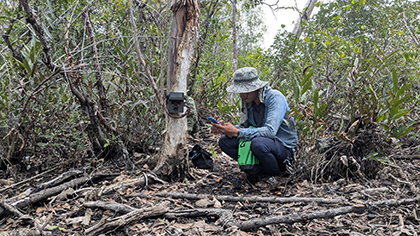
Caption: The FCEE team set up camera traps to monitor population trends and assess conservation efforts in the Koh Kapik Ramsar site © FCEE
Seab leads a team of women caretakers who manage a mangrove nursery. They received training from Fishing Cat Ecological Enterprise (FCEE), a non-profit social enterprise, on techniques to grow more than 14 species of mangrove trees for restoration and ecotourism.
In 2025, the Critical Ecosystem Partnership Fund, with funding from Canada’s International Biodiversity Program, supported:
- the planting of 2,000 trees
- training on nursery management
- the cultivation of diverse mangrove species
- the use of restoration techniques
This contributed to the ongoing restoration of 400 hectares of mangrove forest.
The impacts of climate change are getting worse. Coastal communities like Koh Kapik will increasingly depend on healthy mangroves to protect them from storm surges and erosion.
FCEE also collaborates with local communities, rangers and authorities. Working together, they strive to understand the spread and density of priority species within the habitat. Patrol team members receive training in camera-trap survey implementation. These traps have confirmed the continued presence of target species:
- hairy-nosed otter
- smooth-coated otter
- fishing cat
- large-spotted civet
“We are also supporting women in the community so they can become future leaders in conservation,” said Vanessa Herranz Muñoz, the director of FCEE.
Women received training in conservation-conscious small business development. They created mangrove kayaking tours and provide hospitality for ecotourism through the Koh Kapik Community Protected Area (CPA) Committee, a local community-based organization. A high-end resort now brings tourists on the tours. This supports local livelihoods and the CPA’s conservation fund.
FCEE has observed a shift in local attitudes. “Illegal logging and trapping have decreased significantly,” said Roth Vichet, a biodiversity researcher. “People have also joined restoration efforts.” In 2025, each patrol found 1 or 2 prohibited activities, while there were 3 found per patrol in 2024. No snares were found in 2025.
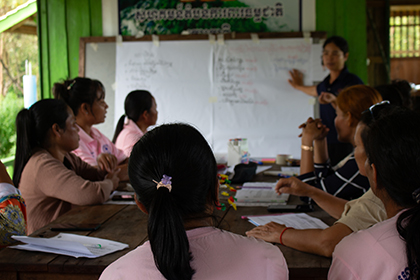
Caption: Women participating in training on mangrove restoration and planting
© IUCN Cambodia/Image by Buth Chanmeta
Six sites in Cambodia now provide business development and priority species training to local women, as well as camera-trap surveys.
“We must continue to take care of the mangrove forest,” said Seab. “Not only for our community but for the whole country.”
- Date modified:
