
Finding safety amid sirens: Ukraine’s child-friendly spaces
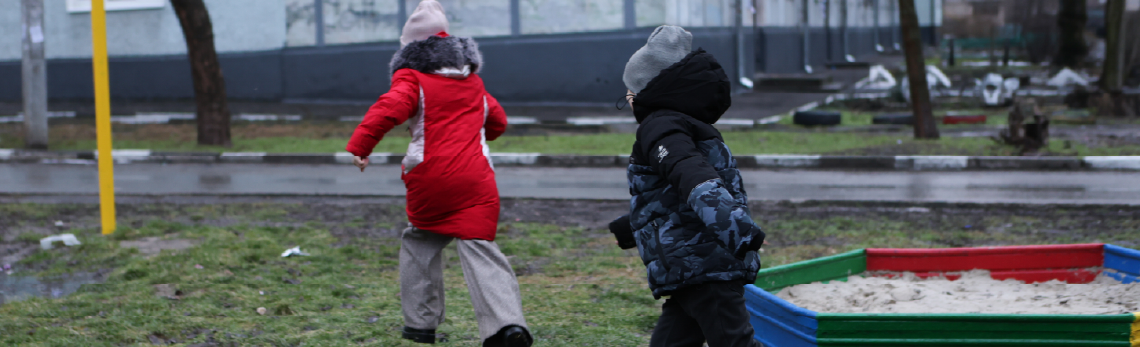
In Ukraine’s eastern regions, childhood has been reshaped by war. Air raid sirens cut through school days. The distant rumble of bombs is never far away. Across the country, over 3,000 children have been killed or injured since the war started. Nearly a quarter of Ukraine is contaminated with mines and explosive remnants, putting millions more at risk. For children growing up in this environment, fear can quickly replace the ordinary routines of childhood.
Ten-year-old Denis knows this reality all too well.
He lives with his grandmother, Oksana, who works as a cleaner at a local school. Since the escalation of the war, their community has faced regular shelling. Fear has become part of everyday life.
“I'm afraid to be alone when there are explosions. When I hear sirens, I freeze and cover my ears,” Denis says.
Like many children living near active hostilities, Denis began to withdraw. Loud noises made him panic. Social interaction felt overwhelming. What had once been an ordinary childhood slowly narrowed into a world defined by caution and anxiety.
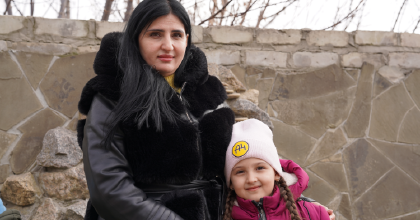
Photo credit: © Anastasiia Zahoskina/ Save the Children
Caption: Ivanna hugs her daughter Alina outside of a child-friendly space in Kharkiv region, Ukraine.
When fear brings silence
For Ivanna, 43, the war took an even deeper toll on her youngest children.
During heavy bombardment, the family took shelter in a basement. One night, the structure collapsed under constant shelling. The experience severely affected her son David and daughter Alina, who were 3 and 5 years old at the time.
“At the beginning of the war...my youngest son [David] used to talk, used to sing songs,” Ivanna recalls. “But one night, the basement collapsed on us. And David stopped talking.”
“It’s very painful when your son used to talk, but then he became silent and he no longer says even, ‘mother’.”
Her daughter Alina also struggled after the incident. She began to stutter, her speech halting and uneven after the trauma.
That same night, her eldest son Danil counted a total of 763 rocket attacks before he finally stopped.
A caregiver’s dilemma
For Oksana, the emotional strain was constant. She needed to work to support her family, but leaving Denis alone during frequent air raid alerts felt impossible.
“Since the beginning of the full-scale war, we have been living in constant anticipation of shelling,” Oksana explains. “I simply cannot leave Denis unattended, but I need to earn a living.”
Ivanna faced a different but equally difficult situation. Her home had been destroyed during the war—stripped down to its walls and foundation. Windows were gone, and the belongings inside stolen.
Now living in a rented flat and receiving government support, she can only work part-time, constantly balancing the need to earn a living with caring for her children.
“Where we used to live, where we had a house…there is nothing there,” Ivanna says. “We are trying to provide children with everything they need so that they can develop and can return to the life they had before the war, morally and physically.”
Across eastern Ukraine, many families face similar challenges. Safe places where children can play, learn and cope with what they have experienced are rare. Caregivers—many of them women—carry the heavy responsibility of attempting to shield their children from trauma. They do this while navigating the constant uncertainty of providing for their families in wartime.
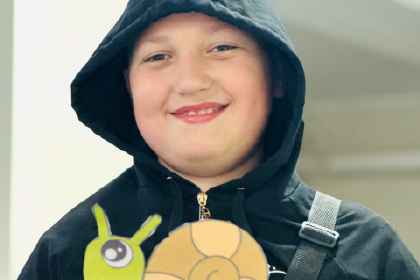
Photo credit: Gorobets Olesia / Save the Children
Caption: Ten-year-old Denis holds a craft he made at a child-friendly space in Kharkivska oblast, Ukraine.
A safe space for children
Oksana and Ivanna reached a turning point when they discovered free programs at nearby child-friendly spaces. Supported by Save the Children Canada, these spaces are part of a humanitarian response funded in part by the Government of Canada. Running in close partnership with local organizations, they offer more than just activities. Here, children can play, learn and feel safe in a structured and welcoming environment. Trained facilitators are there every day, offering support in ways that respect each child’s culture and reflect the needs of their community.
For Oksana, the impact was immediate.
“As soon as I found out that there were free classes for children [in child-friendly spaces], I immediately took my grandson there,” Oksana said. “And while Denis is under supervision, I can work with a calm mind.” When Denis first arrived, facilitators noticed how cautious he was.
“At first, Denis avoided loud games and was afraid of any sharp sound,” says Olena, a facilitator at the child-friendly space. “Thanks to creative activities and the support of his friends, he became more open and felt safe.”
Through art, games and group activities, Denis slowly reconnected with others. He started drawing, making crafts and participating in group play. These simple routines—playing, laughing, sharing ideas—became small but important steps toward rebuilding his confidence.
“Now, my grandson is not just existing in the midst of war, but is living his childhood again. You opened up here and gave children back the sense of security that was lost because of the war.”
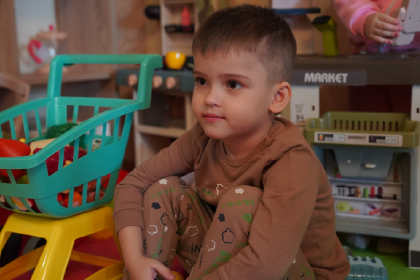
Photo credit: © Anastasiia Zahoskina/ Save the Children
Caption: David plays with toys at a child-friendly space in Kharkiv region, Ukraine.
Restoring a sense of normalcy
A similar experience unfolded for Ivanna’s youngest children.
When they returned to their home city, there were no psychologists available to help David. At the child-friendly space, he was able to meet specialists who helped him find his voice again. He regained the ability to speak in full words. Ivanna credits his progress “thanks to the professionalism of facilitators here and their approach to the child.”
Alina also began to improve. Through play, art and shared activities, her confidence grew and her speech became more steady. For Ivanna, seeing her children laugh, speak and play again—even for a few hours—has been a relief and a sign of hope.
Helping children heal
The experiences of Denis, David and Alina highlight not just individual progress, but also the program’s wider impact. By the end of the initiative, 1,847 children across eastern Ukraine had accessed child-friendly spaces, where they could play, learn and receive psychosocial support. An additional 1,002 children received individualized child protection case management tailored to their specific needs.
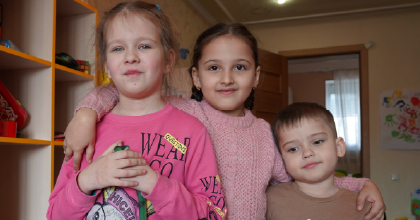
Photo credit: © Anastasiia Zahoskina/ Save the Children
Caption: Alina hugs her friend and her brother David at a child-friendly space in Kharkiv region, Ukraine.
* Names have been changed to protect identity.
Mobile outreach teams also extended support to families in hard-to-reach communities. Two mobile units reached 5,950 people—including 4,119 children—through awareness sessions and direct assistance related to protection and the prevention of sexual and gender-based violence. The results have been encouraging. All surveyed children and caregivers reported improvements in children’s wellbeing after completing structured psychosocial activities. Meanwhile, 98% reported accessing protection services, reflecting greater awareness of available support.
Child-friendly spaces serve not only as places for play, but also as entry points to broader protection services. Families can receive referrals, guidance and support when children face heightened risks.
For children like Denis, David and Alina, these spaces offer something just as essential: a sense of normal life.
In a region where sirens still interrupt daily routines, the chance to laugh with friends, focus on a creative activity or simply feel safe for a few hours can make a profound difference.
For caregivers like Oksana and Ivanna, it offers reassurance that their children are supported, understood and not alone.
And for the children themselves, it is a chance—however small—to rediscover what childhood should feel like.
- Date modified:
