
Ecominga
Canada recognizes that protecting biodiversity abroad and at home helps build strong, sustainable economies and creates healthier and more resilient societies. Canada’s 2023-2026 International Biodiversity Program helps developing countries to fulfill their commitments. The Kunming-Montreal Global Biodiversity Framework helps to restore, conserve and sustainably use biodiversity.
Canada helps to fight plastic pollution in Ecuador
In the lush Manduriacu Valley of Ecuador, where rare amphibians have been rediscovered and rivers sustain both people and crops, the problem of plastic waste had become impossible to ignore. In the communities of Cielo Verde and Villaflora de Manduriacu Grande, families who depend on pitahaya (commonly known as dragon fruit) and plantain farming faced a growing challenge: the plastics used to protect their crops, store agricultural inputs, and support production were accumulating across the landscape.
With no waste collection service, residents had few options. Used plastics were routinely burned, buried, or washed by rain into the streams that run through this biodiversity-rich valley - affecting both ecosystem health and community well-being.
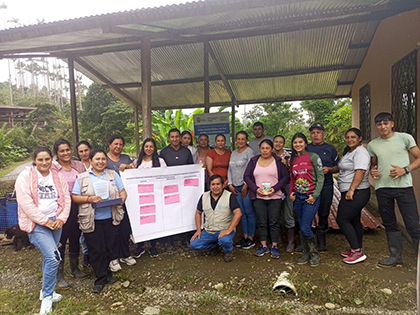
Photo credit: © David Monteros – Ecominga – Biofabric Workshop
With support from Global Plastic Action Partnership (GPAP) and funding from Canada’s International Biodiversity Program, local leaders and producers took the first essential step: understanding the scale and nature of the problem. Through collaborative workshops, community data gathering, and open dialogue, they moved from recognizing the issue to designing practical, community-led solutions.
They mapped where and how plastics were being used throughout the agricultural cycle, identified a suitable location for a small plastic recovery centre, and strengthened awareness of the environmental and health risks associated with burning or improperly disposing of plastic waste.
The project’s impact extends well beyond waste management. It has helped strengthen cooperation and lay the groundwork for long-term change. A new biofábrica (biofactory) is now being developed, enabling farmers to produce their own natural fertilizer (biol) and reduce dependence on chemical fertilizers that come packaged in plastic. This transition not only lowers production costs, it also supports healthier soils, cleaner water systems, and more resilient farming practices.
Results have been encouraging
- Sustainable production practices have expanded: 2,789 litres of biol were used by 28 farms, reducing reliance on externally purchased chemical inputs and associated plastic packaging.
- Plastic leakage is actively reduced: Farmers collected 1.356 tonnes of agricultural plastic waste in December 2025 alone, diverting it from burning and dumping on waterways in a biodiversity-sensitive landscape.
- Community participation has been institutionalised: 54 farming families across Villaflora and Cielo Verde are now engaged in structured plastic recovery and improved waste management practices.
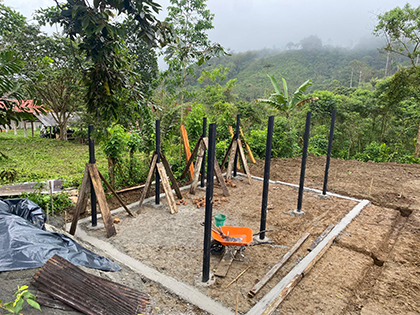
Photo credit: © David Monteros – Ecominga – Biofabric Facility
As one farmer shared, “Burning plastic was what we always did. But now we understand that everything comes back to us. We don’t want to continue this way.”
Another added, “Now we know it’s possible to make our own natural fertilizer and work toward 100% organic crops. We’re already seeing results from selling biol.”
This shift has changed daily routines. Farmers now separate waste instead of burning it, produce biol using local inputs, and rely less on chemical fertilizers. Selling surplus biol provides an additional source of income, improving livelihoods while protecting health and the environment.
What began as a local concern has become a model of community-driven action, demonstrating how reducing plastic pollution and advancing sustainable agriculture can simultaneously protect ecosystems, improve human health, and strengthen livelihoods—outcomes that align with global environment and development goals.
For Canada, this initiative demonstrates how community-led action can deliver measurable progress on biodiversity protection and plastic pollution reduction with global relevance.
- Date modified:
