
Canada helps Honduras strengthen Indigenous land rights
Canada recognizes that protecting biodiversity abroad and at home contributes to building strong, sustainable economies and creating healthier and more resilient societies. Canada’s 2023-2026 International Biodiversity Program helps developing countries to fulfill their commitments under the Kunming-Montreal Global Biodiversity Framework to restore, conserve and sustainably use biodiversity.
In Honduras, many protected areas are not empty lands. They are home. Forests, rivers and coastal waters overlap with the lands and territories of Indigenous and Afrodescendant Peoples. For generations, these communities have cared for nature using knowledge passed down over time. Their way of life is built on respect, balance, and a deep connection with Mother Earth.
Because of this, the rich biodiversity found in these areas is no accident. It reflects the care and stewardship of these communities. Yet, even with their important role, they have often been left out of decisions that affect their own lands.
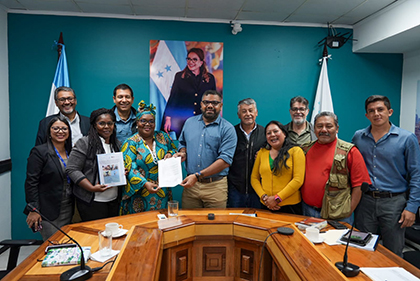
Credit: © Jennifer Cerrato/ICF
Representatives from ICF and IUCN, alongside leaders ofthe Tawahka, Lenca and Garífuna communities
For many years, Indigenous and Afrodescendant Peoples in Honduras (PIAH) have faced serious challenges. They are often treated as stakeholders instead of rightsholders. This means they are consulted at times but not truly included in decisions. In some cases, decisions about protected areas have been made without their input. This has led to limits on traditional fishing, harvesting and even access to sacred sites.
Land rights have also been a long-standing issue. Many communities continue to struggle for legal recognition of their territories. Without this, it becomes harder to protect their land, culture, and way of life.
But change is beginning to take shape.
In response to these challenges, the Forest Conservation Institute approved the National Strategy for Indigenous and Afrodescendant Peoples in the Conservation of Nature and Natural Resources 2026–2035. This strategy was developed in partnership with PIAH organizations and with the technical assistance of the International Union for Conservation of Nature (IUCN) through consultations and workshops.
Support from Canada helped make this work possible. Through the Community-based Conservation of Coastal-Marine Biodiversity in Honduras project, funding supported collaboration between community organizations and conservation experts. This project was part Canada’s International Biodiversity Program, implemented by the CGIAR Science Program on Multifunctional Landscapes.
The new strategy marks a significant step forward. It reflects years of efforts and advocacy by Indigenous and Afrodescendant communities. More importantly, it shifts the focus toward a rights-based approach to conservation.
At its core, the strategy aims to ensure these communities can fully exercise their rights. This includes taking part in decisions about how protected areas are created, managed, and governed. The strategy also supports their role in restoring and using natural resources in sustainable ways.
A key part of the strategy is Free, Prior and Informed Consent. This means communities must be informed and agree before decisions are made that affect them. The strategy also supports stronger local governance systems and recognizes the value of traditional knowledge.
It highlights the importance of collective land ownership and respects the rights of communities to decide their own future. This includes setting priorities for conservation and development that reflect their culture and values.
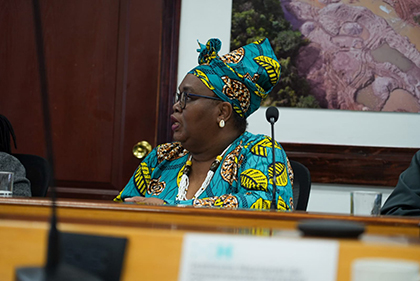
Credit: © Jennifer Cerrato/ICF
Gregoria Jimenez – President of ODECO
The strategy helps Honduras fulfill its international commitments, such as the Convention on Biological Diversity and its 30x30 target, the Paris Agreement, and the Escazú Agreement.
Most of all, this strategy represents a shift in how Indigenous and Afrodescendant Peoples are seen. It recognizes them not just as participants, but as leaders in protecting nature.
“This strategy outlines all the actions that can be developed from our perspective, considering and recognizing our rights and allowing us to participate as subjects of action and not as objects,” said Gregoria Jiménez, Garífuna leader and president of the Organización de Desarrollo Étnico Comunitario.
- Date modified:
