
Canada helps Peruvian women drive forest conservation
Canada recognizes that protecting biodiversity abroad and at home contributes to building strong, sustainable economies and creating healthier and more resilient societies. Canada’s 2023-2026 International Biodiversity Program helps developing countries to fulfill their commitments under the Kunming-Montreal Global Biodiversity Framework to restore, conserve and sustainably use biodiversity.
Until a few years ago, women in the districts of Colasay and Chontali, in Cajamarca, Peru were involved in conservation, but mostly behind the scenes. They cared for water, managed seeds and firewood, and upheld responsible forest-use practices. Yet their opinions rarely influenced decisions about the territory.
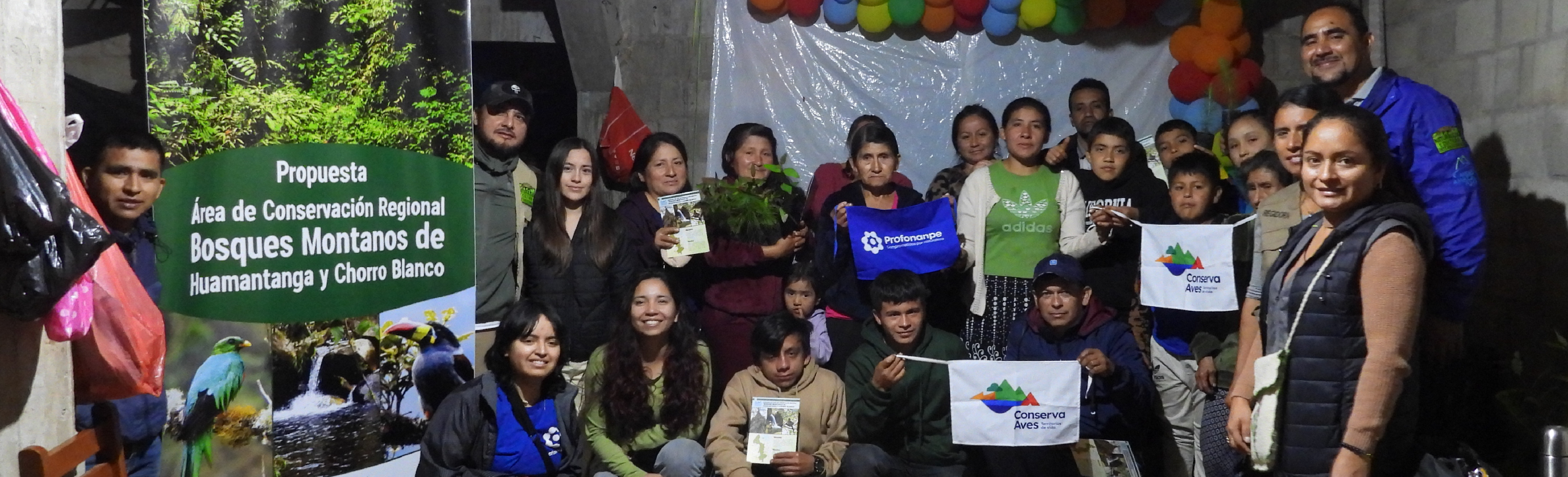
This began to change with the creation of the first steering committee for the future Mountain Forests Regional Conservation Area of Huamantanga and Chorro Blanco. The committee was part of the declaration process led by the Cajamarca Regional Government, with technical support from Naturaleza y Cultura Internacional and backing from the Andes Amazon Fund and the Conserva Aves Initiative partially funded by Canada’s International Biodiversity Program.
This territory is home to mountain forests crucial for water supply, ecological connectivity, and the survival of high-Andean and migratory birds such as the Canada Warbler and Swainson's Thrush, which are sensitive to forest loss.
Credit: Alberto Genaro – Naturaleza y Cultura Internacional
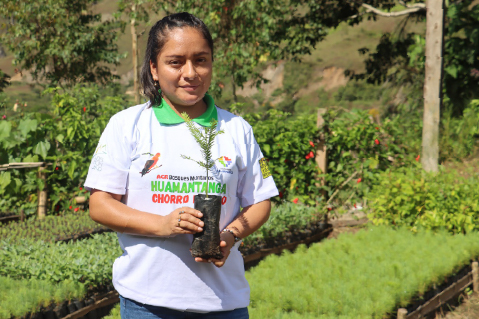
Elena Cruz at the Colasay District Municipality’s nursery.
Elena Cruz Huancas is a forestry engineer, a municipal official in Colasay, and the current President of the steering committee. Her leadership is rooted in a lifetime of connection to forests and river ravines, an experience that shaped her identity and commitment to conservation.
Becoming president was a natural step for Elena, recognized by her community as a defender of water and mountain ecosystems. Her leadership style is approachable and horizontal, linking conservation with collective well-being and future generations.
From the start, the project focused on intentionally including women and young people with local roots. Workshops for women were organized, coordination across the territory was planned, and conditions were created for effective, meaningful participation.
"Women were always involved, but they were invisible. Today, with the committee, our ideas and knowledge are finally being heard," says Elena, recalling how the committee transformed women’s participation in the territory.
"Conservation has a greater chance of being sustained when women lead because they think of their children and the future of the territory," notes Ivan Mejía, coordinator of the Naturaleza y Cultura Internacional-led project that supported the process.
Credit: Alberto Genaro – Naturaleza y Cultura Internacional
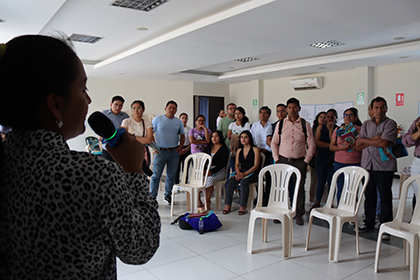
Elena leads a community workshop.
Elena's presence was key to strengthening community trust, facilitating outreach, and reducing initial resistance. In the working spaces, she promoted dialogue, led groups, and linked conservation with issues such as women's rights and the valorization of local knowledge.
Since the formation of the steering committee, women participate with greater confidence, propose ideas, and see themselves as central actors in governance. Topics such as crafts, sustainable farming, and cultural heritage are now part of the conservation conversation.
"Trusting in our capacity and losing fear can transform entire communities," affirms Elena, sending a message to other young women who could lead similar processes.
This project is part of the Conserva Aves Initiative, which protects habitats for birds and communities, led by the American Bird Conservancy, the National Audubon Society, Birds Canada, BirdLife International, and RedLAC with the support of the Government of Canada.
In Peru, the project is led by Profonanpe and Asosiación Ecosistemas Andinos (ECOAN), in collaboration with six local partners, including Naturaleza y Cultura Internacional (NCI).
- Date modified:
