
Canada supports Kenya’s youth turning waste into jobs
Canada recognizes that protecting biodiversity abroad and at home contributes to building strong, sustainable economies and creating healthier and more resilient societies. Canada’s 2023-2026 International Biodiversity Program helps developing countries to fulfill their commitments under the Kunming-Montreal Global Biodiversity Framework to restore, conserve and sustainably use biodiversity.
In rural Kiambu County, Kenya, worms and insects are emerging as a source of livelihood and a means of producing bio-fertilizers that improve soil health for both rural and urban farmers. A youth-led business called Comfort Worms and Insects is turning organic waste into natural fertilizers that support farmers.
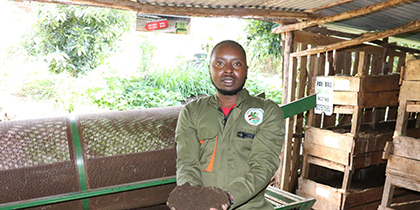
Credit: George Muturi
George Muturi, CEO of Comfort Worms and Insects Ltd.
The business is supported by the Biodiversity for Resilient Ecosystems in Agricultural Landscapes (B-REAL) project funded by Canada’s International Biodiversity Program which is implemented by the CGIAR Science Program on Multifunctional Landscapes (MFL).Comfort Worms and Insects started in 2018 as a small youth initiative. At first, the group raised worms and insects to feed household chickens and produce organic manure, largely for subsistence. Over time, the idea grew into a successful business. Today, it shows how recycling organic waste can create jobs while protecting the environment.
Through support from B-REAL and MFL, the company has improved how it collects and processes waste. It has strengthened its technical skills, improved product quality, and built stronger market connections. Starting with a production capacity of 4-6 tons per month, the company now produces about 12-16 tons per month. As a result, domestic animal-derived and market-derived organic waste that once accumulated in the markets of Kiambu and its environs is now converted into high-quality vermicompost and insect-based soil enhancers.
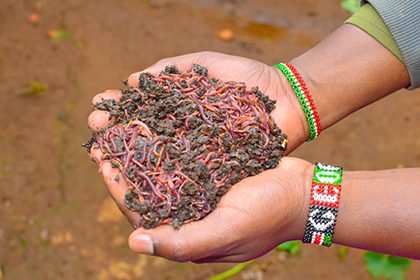
Credit: George Muturi
Production of vermicompost using red worms.
In the last year, the partnership has empowered more than 300 youths from 15 youth groups in Kiambu County. They learned how to produce vermicompost, rear Black Soldier Flies, keep business records, and market their products. One youth group received a vermicomposting starter kit with a four-level composting stand and worms to begin production. Altogether, this has created meaningful employment opportunities for local youth as agri-enterpreneurs, particularly young women, who are now engaged in waste collection, processing, packaging, and marketing of the bio-inputs. Beyond income generation, the enterprises contribute to meeting the huge demand for organic farm inputs. This supports healthier soils, reduces negative environmental impacts, and enhances productivity among smallholder farmers while reducing the use of costly synthetic fertilizers.
Within a year, the enterprise has delivered significant environmental and socio-economic results. An estimated 120–190 tons of organic waste are now diverted annually from markets and livestock systems into productive use, reducing environmental pollution and greenhouse gas emissions associated with unmanaged waste.
Youth trained through the initiative are not only participating in production but also earning income as suppliers and distributors of bio-inputs. Farmers using the vermicompost report improved soil structure and moisture retention. As a result, they can reduce their use of synthetic fertilizers and lower production costs.
This model shows that youth-led businesses can solve multiple problems at once. In Kiambu County, a simple idea – turning waste into value – is helping build a more sustainable and inclusive agricultural future.
- Date modified:
